
 Shiina Labs
What happens to a developer’s decisions when the cost of shipping an experiment stops being worth counting?
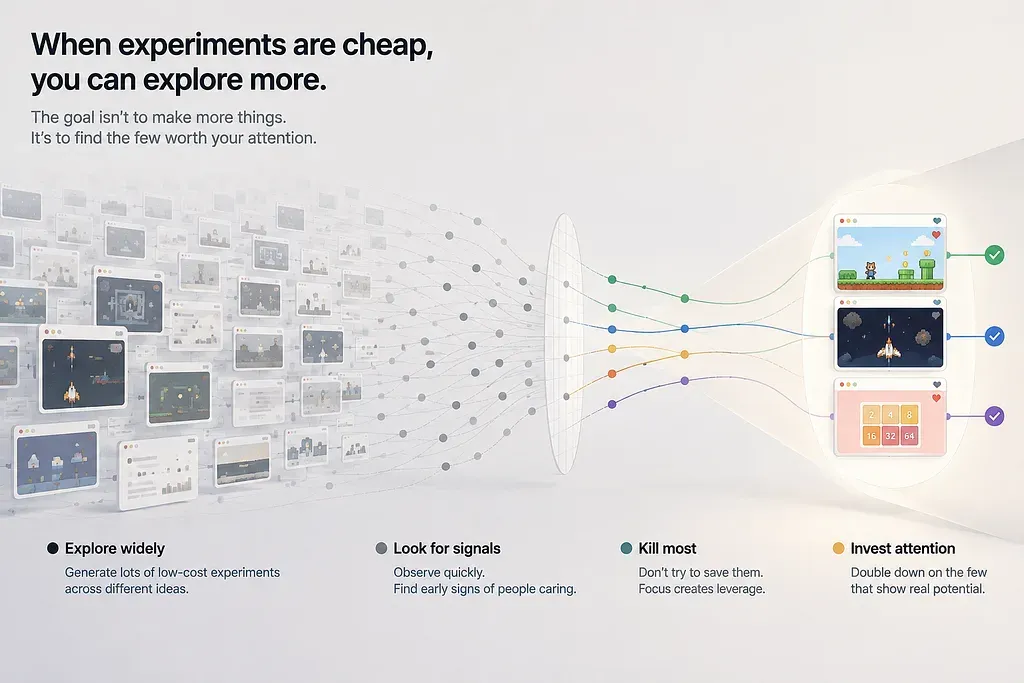
When experiments get cheap enough, the goal is no longer to make more things. It is to search more broadly, filter faster, and invest attention in the few ideas that actually show signal.
Recently I hit a problem I’d never expected: a pile of cheap, mid-tier model credits that are hard to run out of.
They aren’t the strongest models. For complex architecture, important decisions, or work that needs real reasoning, I still reach for something better. But most day-to-day development isn’t that hard: editing pages, adding small features, cleaning up code, rerunning tests, fixing errors from logs. Cheap models handle it.
I used to think about how to save tokens. Now I think: if these credits will sit there unused anyway, can I trade them for something else?
This isn’t a postmortem. The experiment just started. I have no traffic curve and no number that proves the strategy works. It’s a judgment I’ve formed recently, and one thing I’ve started doing because of it.
Cheap models are moving from “fallback” to “default”
Cheap models no longer feel like the “not good enough, but we need to save money” fallback. When Google introduced Gemini 3.6 Flash, it called the model a workhorse, emphasizing coding, agentic work, token efficiency, and large-scale execution. Google’s Managed Agents later made 3.6 Flash the default.
The workhorse model for agents is getting cheaper.
The division of labor isn’t new. Claude Code has long kept a “main model” and a “small and fast model” as separate roles. The official model config docs still show ANTHROPIC_MODEL and a deprecated ANTHROPIC_SMALL_FAST_MODEL, which ANTHROPIC_DEFAULT_HAIKU_MODEL replaced for Haiku and background work. The idea was always there. It was never cheap enough for me.
Model routing used to answer one question: how do I make an expensive agent a little cheaper? I’m asking a different one now:
What happens when most agent steps are so cheap that I stop counting them?
What Dropped Is the Cost of One Experiment
An API call dropping from a few cents to a cent doesn’t change how I build products. What changes behavior is the total cost of going from an idea to something shippable. That cost has dropped.
I used to run the math on any small web project: design, code, debug, style, deploy, maintain. If the thing might bring a sliver of traffic and cost me two or three days, I’d probably skip it.
Now an agent can read code, edit, test, fail, read logs again, edit again, and run another round on its own. That might be dozens of model calls. As long as the steps stay cheap, what I spend narrows to describing what I want, checking results, making trade-offs, and deciding whether to continue.
How much does it cost me to turn an idea into a real, shippable experiment?
Once that cost drops, things that weren’t worth doing move into “worth trying” territory. That’s how I ended up making tiny games.
I started spending idle compute on tiny games
I’m building small web games, purely as a vehicle for experiments: no plan to become a game studio, no proof that games attract traffic.
A tiny game has clear boundaries. Most need no backend, run on the front end alone, deploy standalone, and can sit in the same collection as other games. Someone who finds one through search or a shared link can play it, then browse the rest or land on my other pages.
When shipping something costs this little, can I run more small experiments to find the few that draw traffic?
I don’t think making more is a competitive advantage. If AI gets cheaper for everyone, everyone can produce more web pages, apps, posts, and games. Adding supply stops meaning anything on its own. What I want is a bigger search space.
Before, I could only pick one idea carefully, because each try was expensive. If trying is cheap, I can test more candidates at once, drop the ones with no signal fast, and keep my time for the few that show signs.
The framework I use now
Produce candidates cheaply → observe → eliminate most → focus attention on the few with signal.
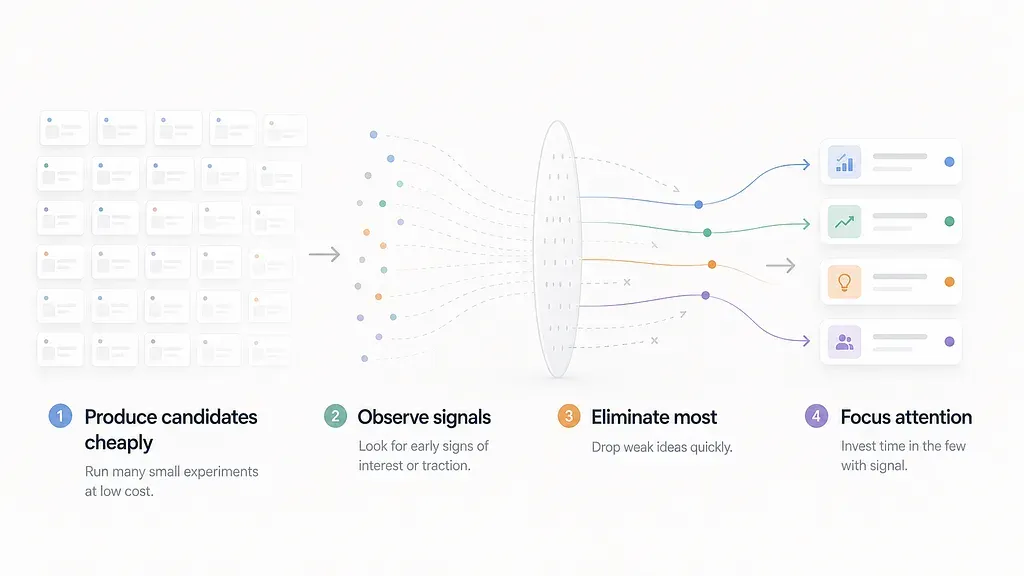
This is the framework I am experimenting with: produce candidates cheaply, observe early signals, eliminate most of them quickly, and focus time and attention on the few that are worth deeper investment.
AI expands how cheaply I can explore candidates, not how many products I can maintain. Generation keeps getting cheaper, but judgment, filtering, and continued investment stay with me: a project with no signal should stop taking my time soon; only something showing a little value deserves SEO, content, or long-term upkeep.
So I’m not producing more content to fight for attention. Attention is scarce. Cheap exploration matters because it finds the few things worth my attention.
What I want to test: where the bottleneck moves
The experiment just started, so I can’t claim distribution is the bottleneck. It’s my current guess.
If production costs keep falling, I suspect the scarce thing shifts from “can it be built” to:
- Distribution
- Attention
- Choosing what to work on
- Taste and judgment
- User trust
- Maintenance
- The developer’s own attention
The last one is the most visible to me: what AI can generate and what I can manage are two different things.
Even if I ship ten tiny games quickly, I still have to judge which to keep, which to shut down, which deserve SEO, which metrics matter, and where real demand exists. Once generation outpaces my capacity to manage, generating faster stops being useful. Filtering becomes the job.
I also treat models as tiers of labor instead of one model at the center of a workflow: cheap models for routine tasks, stronger models for hard ones, escalation on failure, and the strong model straight to high-stakes decisions. Which exact model wins changes in months. The structure can stay.
No answer yet
I don’t know what happens to these games. Maybe none of them gets traffic. If so, the experiment still tells me something: cheaper production doesn’t automatically create distribution. Or a few games pick up search traffic and become doors to other projects, and I put more time into those signals. It’s too early to pretend I have a conclusion.
One change is already real:
I used to skip this kind of experiment because it wasn’t worth days of development. Now it’s cheap enough to try.
I used to spend effort using less model capability. For the first time, I’m thinking about how to trade surplus capability for something scarcer.
Right now, the thing I’m trading it for is traffic.
Where the bottleneck lands, I’ll see after these experiments run for a while.